
The Atlanta-based alt-rocker talks his debut EP, ditching industry pressures and finding his voice as a solo artist for the first time in his life.
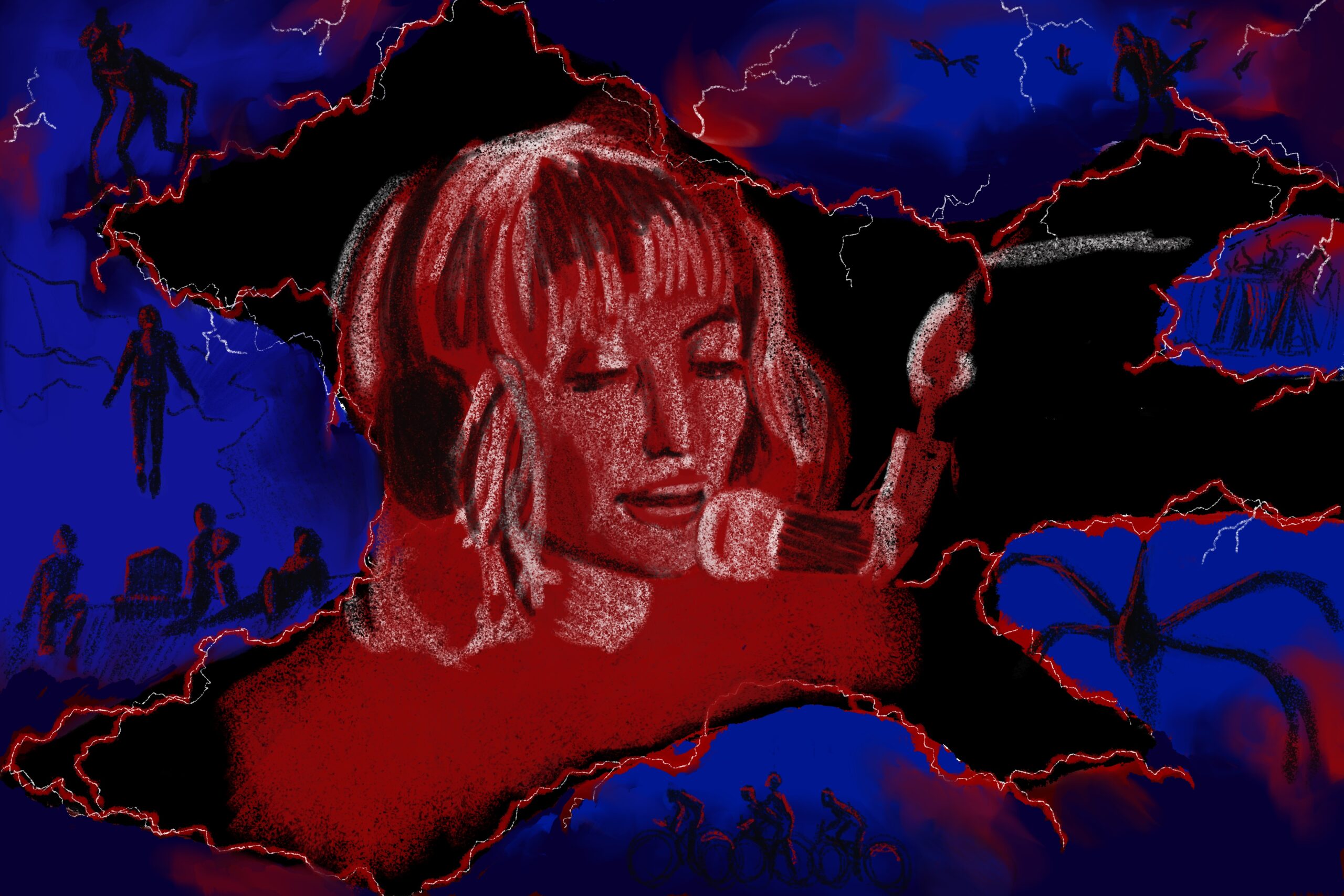
Header illustration courtesy of Samantha Rackley (@MelotineCookies).
For Beau Anderson, it’s been a long road to going solo. The Atlanta-based alt-rocker has bounced from band to band (including the uber-successful indie group Seven Year Witch), touring and becoming what his team describes as “a seasoned road dog,” and writing with industry veterans like Johnny Andrews (songwriter for Three Days Grace, Halestorm, and Gavin Rossdale). But now, for the first time in his career, he’s found his voice. His debut EP as a solo artist, he says, helped him to “fall in love with music again.” Turns out, letting go was the key. And thus, “Soundtrack of Letting Go” was born.
At age 10, Anderson formed a cover band with his childhood best friend, Chase Brown. Aptly named Athens, after the Georgia city in which they lived at the time, it sustained both his and Brown’s hunger for making and performing music throughout their high school years. At age 16, Athens became New Mantra, and his recording career was set in motion. The band’s self-titled album was released in 2015 after being recorded and produced at Full Moon Studios in Watkinsville, Georgia. Aside from the band name, the city of Athens has also played a large part in the way Anderson has approached making music. In the past, he’s described it as a place that harbors a “don’t-give-a-shit-rawness” type of feeling. Generally speaking, Athens has long run rampant with the greats of indie and alternative rock, including heavy-hitters like R.E.M. and Widespread Panic hailing from the city. In terms of how it’s influenced even his new EP, Anderson tells me, “I made it, and Athens made me.”
“But I think a lot of the energy that’s on this EP comes from the music that I love from Athens—very high energy, kind of lo-fi a lot of the time. And I love the lo-fi type of trashy guitar tones,” he continues. “There’s all sorts of music made in Athens, but I think it all is—to an extent—very raw and not overproduced. That’s what comes in with my stuff—just going really raw with it.”
Although New Mantra fell apart just two years later when Anderson was 18, he and Brown found themselves on the hunt for their next project. After spending time in Atlanta, the two became acquainted with Brazilian singer Gio Turra, who invited them to join The Twotakes. Turra, who was studying at the Savannah College of Art and Design’s (SCAD) Atlanta campus, fronted the effort with a number of songs ready to be recorded and performed. In true SCAD student fashion, the band recorded their indie-rock album, “Submarine Races,” in the dorms over winter break. Anderson has joked that the dorms became dorms after being converted from an old Motel 6, and the band “DIY-ed the hell out” of recording the album with a free trial of REAPER. It’s clear that he still holds a sense of fondness for that time in his life, noting that he still has friends in the area as we speak over Zoom.
Anderson greets me from his home studio—once a garage that he’s turned into a professional recording space. “Soundtrack of Letting Go” was recorded in the studio in just over two months during the summer of 2024. “It was far less transactional, you know. It wasn’t like, ‘Oh, I’m paying you a bunch of money, and at the end of the day you’re providing me a service.’ It was just three friends being in a garage and writing and recording,” he says of the experience. “I think that we were able to put a lot of thought into everything. There were no time limits, and we were just kind of going for it. I think a lot of that will come through the music.”
A band and a half plus an EP later, it’s clear that he’s moved up in the world since his days recording in the SCAD dorms—but nonetheless, the collaborative spirit found in the once–Motel 6 has stayed with him well into his solo career. “Soundtrack of Letting Go” was co-written and produced by Brown and their mutual friend Zach Neal. Anderson once referred to Brown as the McCartney to his Lennon—a comparison that quickly prompted the question: How was it determined who’s who?
“Because he is far more responsible and less crazy and goofy, whereas I’m the mess,” Anderson tells me with a laugh. “He said, ‘Oh, you let me be McCartney!’”
And similarly to Lennon and McCartney, Brown has been a part of Anderson’s life—quite literally—longer than he can remember. After meeting through their fathers, who worked together at the time, he was three and Brown was six. He says that actually meeting Brown for the first time predates his earliest memories. Nevertheless, it’s clear that music was ever-present in their lives.
“My first memory of Chase, actually, is his dad coming over to our house so they could meet about something. And meanwhile, he and I start jumping on the couch and watching Power Rangers,” he says. “I had this little toy drum set. I remember him playing on it, and he still has the same stance when he plays drums. I can still see it: I’m jumping on the couch, and he’s got his ‘Chase on drums’ posture.”
After the dissolution of The Twotakes in 2020, Anderson then went on to join the Greenville-native band Seven Year Witch in September of that year. By 2022, they had signed with Larry Mazer—the renowned manager of bands like KISS and Buckcherry. Seven Year Witch then opened for the latter, performing sold-out shows at iconic L.A. venues such as The Viper Room and Whisky a Go Go. After the release of the band’s album “Vampire Calamity” in March of 2024, Anderson found himself feeling unfulfilled. He’s stated that despite his love for the band, “it was time for me to get out.” But as it always goes, the time was finally right for Anderson to become a full-fledged solo act.
Enter “Soundtrack of Letting Go.”
“It’s a unique and interesting experience to be able to just say, ‘Yeah, this is what’s in my head, exactly as it is, and put it out into the world,’” he says of working on the EP. “It’s very interesting to be able to put out a pretty unaltered vision that you’ve got in your head—and that I’ve been enjoying. It’s really cool.”
He also calls the process an “all-consuming” one. Like all musicians, Anderson has kept dozens upon dozens of voice memos consisting of ideas, riffs, and drumbeats—some that made it on the EP dating back five years. It brought him to a collection of songs that tackle various themes surrounding time, aging, and feeling stuck without a solution, with standouts including “Fix It” and “Standing Still.”
“It’s a long, drawn-out process from when you first conceptualize the song or EP or all of it to when it’s actually getting heard. I’m so happy to finally have it all coming out,” he says. “The first song I wrote for all of it was ‘Standing Still,’ and that one was kind of just how I was feeling at the time. I was standing still, and I wanted something new.”
“Standing Still,” along with being the first, features one of the most interesting lines in the entirety of “Soundtrack of Letting Go.” During the bridge, Anderson sings: “Too young to feel old / Too old to be young.” A line that perfectly encapsulates a sense of yearning for a break from the stagnation that’s often felt during the post-college years. However, according to him, it wasn’t necessarily a universal feeling that inspired it.
“I was 25 when I wrote that line. It’s a weird space where you’re relating to 30-year-olds and 21-year-olds,” he tells me. “It’s when you’re supposed to be starting your life. You’re like, ‘Trying to still be in a band at 25—strange, you should be getting a job’—but at the same time, you’re not that old, either. You’ve still got some time. It’s a weird kind of spot.”
Anderson returned to a Lennon-ism with “Fix It.” He tells me that the song is almost as though “Imagine” was flipped on its head. “I was flipping around ‘Imagine’ by John Lennon, kind of like, imagine you have nothing to kill or die for,” he says. “I’m like, that sucks. Give me something to kill or die for.”
“If you’re not feeling there is anything to kill or die for, that’s one of those things you can’t force yourself into. You can’t force yourself into being in love. You can’t force yourself to be motivated,” he continues. “It doesn’t really have a solution. It’s just about lashing out or being frustrated with nowhere to go.”
In three words, he calls the EP “gritty, heavy, and sexy.” But more than that, “Soundtrack of Letting Go” is a testament to the new chapter of Anderson’s career. He’s let go of the pressures the industry can bring, settled into a creative groove with his best friends, and not only has he found his voice—but now he owns it.
As for the future? He recently stated, “My passion is getting in front of new people. Hopefully this record facilitates more of that. We’re already working on the next album. There’s no time to stop. More fun. More music. More shows.”
“Soundtrack of Letting Go” is out now.