Illustration courtesy of Danielle Johnson (@dani_design04)
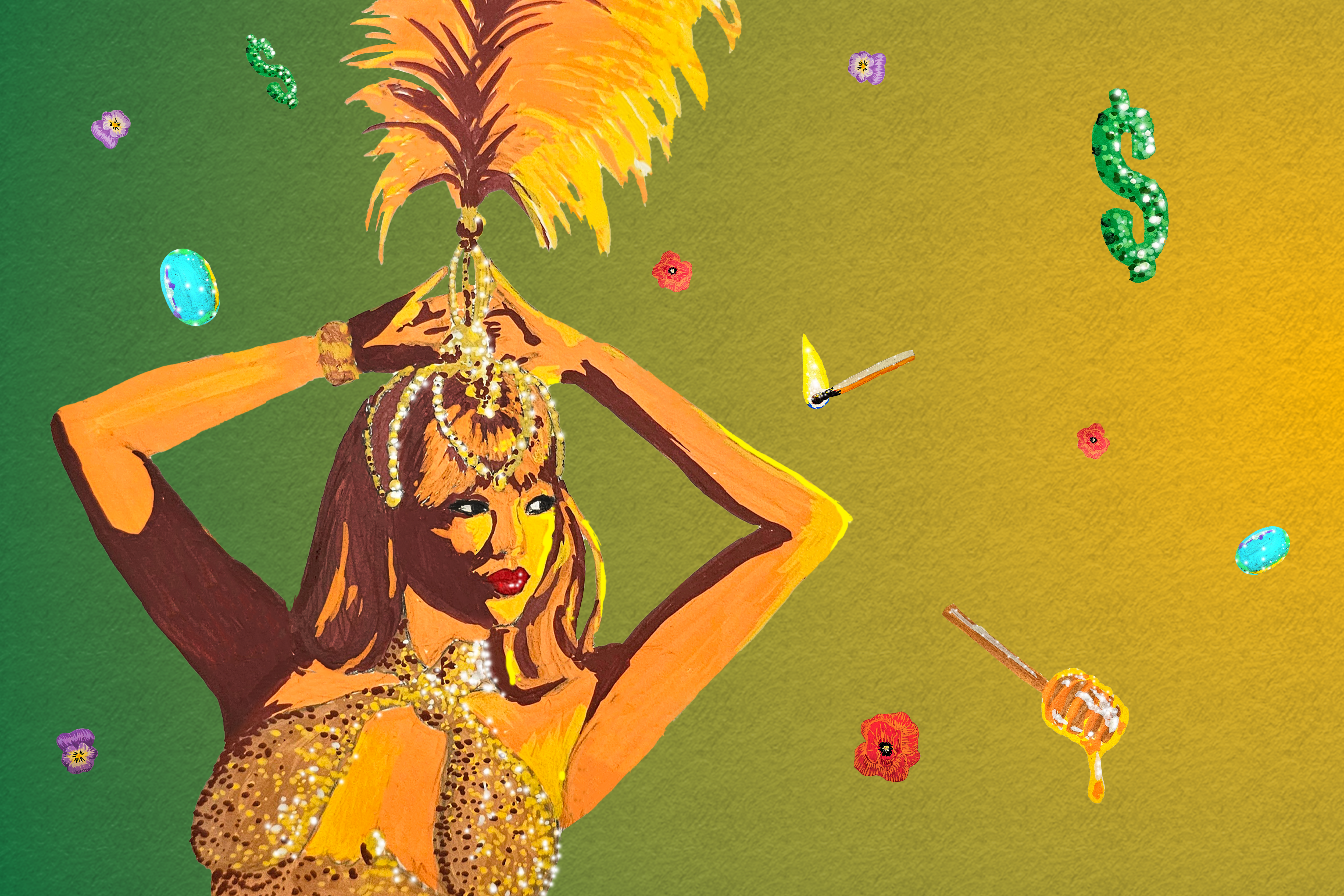
Taylor Swift’s twelfth studio album has done a great deal in the three weeks since its release. “The Life of a Showgirl” has broken records, stirred up endless discourse, and catapulted Swift back into the spotlight after her post-Eras Tour hiatus. But the album, beyond broken records and discourse and the public persona of the world’s most famous woman, failed to recognize its greatest strength. Apart from the interpolations and wide-ranging subject matter, “The Life of a Showgirl” is theatrical and campy in a way that feels like the soundtrack of a Moulin Rouge-style jukebox musical—minus the glitz, glamour, and feather- and rhinestone-filled aesthetic.
With that said, the album’s title track is the exception. Drawing from the Jonas Brothers’ 2019 single “Cool,” with the addition of Sabrina Carpenter’s earworm vocals, “The Life of a Showgirl” is a colorful anthem that feels like a sort of sultry encore to cap off a night of shows on the Las Vegas Strip. Whether or not it came first when making the album, it’s clear that this song fulfilled its duty as the closing track. “Elizabeth Taylor” is the next-closest adherent to the “showgirl” theme. It’s reminiscent of the old Hollywood glamour that the real Elizabeth Taylor is so synonymous with, while leaning into a high-energy orchestral production and proud showcase of Swift’s vocal prowess.
Then there’s “The Fate of Ophelia,” the album’s opener—which could be on a different album entirely. It revisits Shakespeare and references Swift’s savior from the “drowning in the melancholy.” Although it isn’t remiss to say that Shakespeare and theatrics go together, pulling away during the bridge to explain who Ophelia is doesn’t exactly scream “showgirl.” Individually, “The Fate of Ophelia” is one of the best songs on the entire album—bringing back the distinct bassline and catchy chorus that weren’t found on last year’s “The Tortured Poets Department.” But cohesively, it lacks a definitive callback to the album’s overall messaging centered around the life of a glitter-adorned pop star gracing the (literal) world stage.
Nonetheless, “Honey” could also fit on the album “The Fate of Ophelia” aims to be on. A bit less upbeat, it employs a jazzy piano composition that elevates what she did with the comparable “Question…?” on “Midnights” Sonically, it shines—but lyrically, it deviates from the showgirl concept and tells the story of a reclamation of a popular pet name, often used in a demeaning way.
In a musical of Swift’s life and career, “Father Figure” would be sung upon finding out she successfully bought back her masters. It’s an edgy, self-aware song that details her rise from a scorned musical mentee to a powerful mentor. Topped off with breathy and restrained vocals, it’s far from a disservice to the George Michael classic it samples, putting a twist on the original song’s upbeat ’80s sound. Presumably about her long-standing feud with music executive Scott Borchetta, “Father Figure” feels stylistically akin to “I Did Something Bad” rather than “My Tears Ricochet” (another song attributed to Borchetta).
“CANCELLED!,” despite its subpar lyrics, echoes similar subject matter. Detailing the “cancellation” of a friend and Swift’s loyalty to those who stood by her during her own public downfall in 2017, the controlled vocals and orchestral composition create a memorable hook. Both lyrically and sonically, it reads as an impassioned speech sung by the antihero of Swift’s theoretical jukebox musical.
“Opalite,” “Wood,” and “Wi$h Li$t” are where the album strays from theatrics entirely and attempts to provide the next pop anthem. Each song is fun, lighthearted, and sensual (mainly in “Wood,” which makes full use of the word), with instrumentals that are a far cry from her sad, synthy melodies of the past. However, none of the songs play into the idea of “the life of a showgirl.” Instead, they’re more reminiscent of songs like “I Think He Knows” and “ME!” off “Lover” (perhaps due to the return of Max Martin and Shellback). All three feel as though they were scrapped from an earlier project—one with a very different theme and artistic direction.
“Actually Romantic,” a diss of sorts, lives in the realm of “Bad Blood” and “Look What You Made Me Do,” but this time with an interpolation from the beginning of “Teenage Dirtbag.” Drawing comparisons to Regina George’s “What are you, like in love with me or something?” from the 2004 cult classic Mean Girls, the narcotic-like bridge sounds like it could be a last-minute addition to the film’s recent Broadway adaptation.
“Eldest Daughter” serves as the coveted track five, with an updated play on “White Horse’s” “I’m not a princess / This ain’t a fairytale.” Instead, Swift laments, “I’m not a bad bitch / This isn’t savage.” Despite how 2025 the lyrics read, it’s once again a self-aware look into some of the artist’s insecurities. Sure, one could argue that “showgirls” are, like most everyone else—if not more so—tuned into their insecurities. However, the rest of the song implies this is in the context of a new relationship and somehow a reflection of what it’s like being the eldest daughter. Perhaps if it leaned more into Swift’s internal battles with fame and competition (something she hasn’t strayed from in the past), it might fit in better conceptually.
The same could be said for “Ruin the Friendship,” which details a past relationship from high school that never turned romantic, even though Swift wishes it did—only to climax with the revelation that the muse has since passed away. It’s more of a lost vault track about the same muse as “Forever Winter” than anything to do with being on stage.
“The Life of a Showgirl,” while a smash hit with a collection of catchy, fun songs, wasn’t really about the “life of a showgirl.” It’s a record that can’t exactly figure out what it wants to be, with songs that could apply to numerous scenarios. Although it missed the mark aesthetically, if there’s anything to be said about Swift, it’s that if she were to use her discography for the next Moulin Rouge or Mamma Mia!, she isn’t short of songs.