Written by Lydia Wollard. Header illustration courtesy of Maximo Knoll.
I’d be lying if I said I knew what to expect walking into the Trustees Theater to see Richard Linklater’s latest film, “Blue Moon.” The only Linklater film I was familiar with was “Dazed and Confused,” and I tried not to let that early, vastly different work shape my expectations. I’m glad I didn’t, because “Blue Moon” is leagues beyond the laid-back, simple alright, alright, alright. Combining extraordinary acting with brilliant, strategic writing, this film is a striking symphony of eloquence, vulgarity, and emotion that has its audience roaring with laughter one moment and quietly reflecting on love and obsolescence the next.
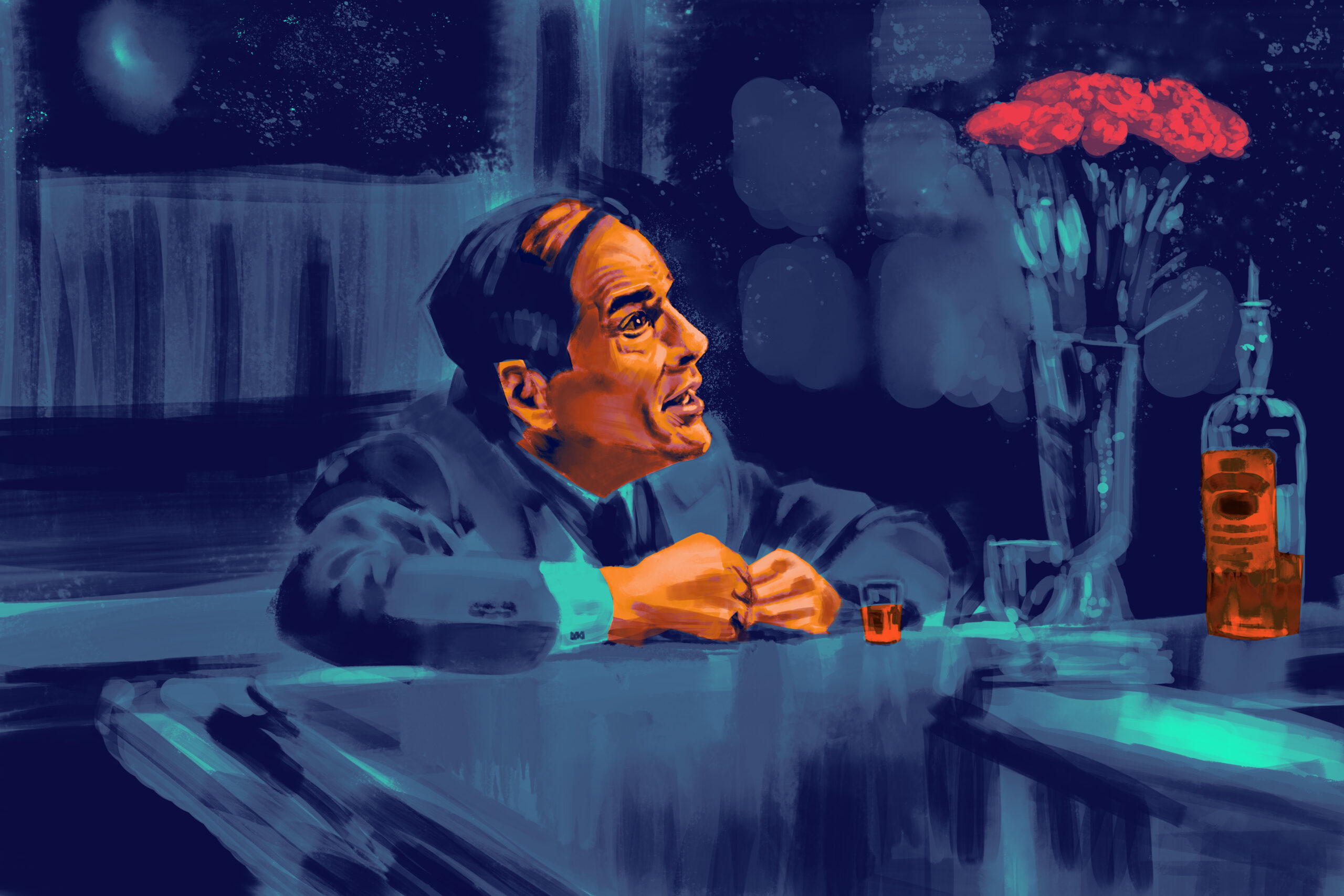
“Blue Moon” offers a fictionalized yet historically inspired portrayal of troubled musical theater lyricist Lorenz Hart’s long, reflective night in a bar while his former collaborator, Richard Rodgers (of Rodgers & Hammerstein), celebrates the premiere of his groundbreaking musical, “Oklahoma!.” Ethan Hawke, as the sharp and tormented Hart, delivers a performance that I’m convinced he was born to give; from start to finish, Hawke channels every ounce of complexity and emotion embedded in Hart’s character, and then some. In a film so intimate and dominated by Hart’s dialogue, Hawke meets the challenge with wit, fervor and remarkable precision, and then some.
Accompanying Hawke for the greater part of the film are Bobby Cannavale as the simple, receptive bartender Eddie and Jonah Lees as bar pianist Morty “Knuckles” Rifkin. Cannavale and Lees’s characters demonstrate considerable depth without stealing too much attention from Hart’s emotional journey, making them the perfect bed of consolation for Hart to fall on as he repeatedly has his heart broken and spirit trampled.
Margaret Qualley stars in the role of Hart’s young prodigé and unrequited love interest, Elizabeth Weiland. Perhaps it was the way Elizabeth was written, but Qualley’s performance was the only one that left me wanting a bit more. She effectively plays a beautiful, intelligent young woman, but her delivery and placement in the film felt awkward and unnatural at times. However, in the end this contributed to the feeling that Elizabeth didn’t feel as enamored with Hart as he did her, so it ultimately made sense for the plot.
The writing in“Blue Moon” was another incredible feature that impressed me from the very beginning. Not many writers can make such a small moment feel so grand and important, but screenwriter Robert Kaplow combined his exceptional storytelling with a thorough understanding of musical theater to craft a script with remarkable depth. The obvious example of Kaplow’s talent would be in Hart’s dialogue, which features multiple ramblings and reflective monologues that define the simultaneous genius and naivety of his character. The lack of profundity in the supporting characters’ dialogue may be a point of dissatisfaction for many viewers, but it’s important to remember that at its core, “Blue Moon” is fully and wholeheartedly centered around Lorenz Hart.
With that in mind, one can really appreciate how well the supporting characters’ reactions to Hart’s remarks, both absurd and clever, amplify his sentimental journey throughout the film. Especially prominent, in my opinion, were the conversations between Hart and Rodgers; they shared a healthy balance of praise and criticism for Hart’s flawed habits and alcoholism. Rodgers is the only character who really gives Hart a taste of reality. If it weren’t for the interchanges between the two, it wouldn’t be nearly as clear why Hart had been left behind by Rodgers in the creation of “Oklahoma!.”
I may have had no clue what to expect when I decided to see “Blue Moon” at the SCAD Savannah Film Festival this year, but I am certainly grateful that I did. No matter what one’s knowledge of musical theater before watching the film (I had none), I would without a doubt recommend it to anyone with an appreciation for outstanding acting and writing. Turning one night into an entire movie is no small feat, and I admire Linklater’s ability to turn what feels like an intimate stage play into a complex, beautiful film that had me hooked from beginning to end. All in all, “Blue Moon” does an excellent job of telling us a heart-wrenching story of art, passion, and struggle, and I can’t wait to tell everyone I know to check it out for themselves.